
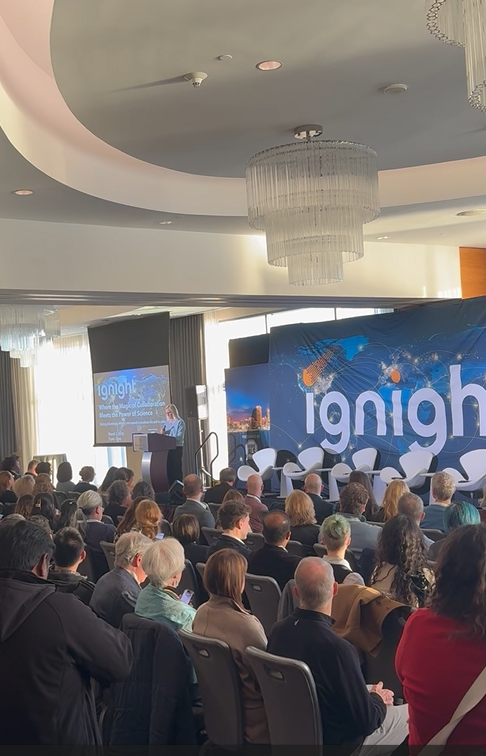
Magic usually involves smoke and mirrors, but the researchers filling the Four Seasons Hotel ballroom in Baltimore for Answer ALS’s “IgNight: Where the Magic of Collaboration Meets the Power of Science” on March 1 proved that the most impressive tricks involve data, cloud computing, artificial intelligence, and scientists who won’t take impossible for an answer. Answer ALS hosted IgNight as the opening event for the Robert Packard Center’s 26th Annual ALS Research Symposium, bringing together researchers, philanthropists, and leading names in AI and cloud computing to talk about where ALS research is headed and how fast it can get there.
The Packard Symposium is one of the most respected gatherings in ALS research. Founded in honor of Robert Packard, who was diagnosed with ALS in 1999 and created the Robert Packard Center for ALS Research at Johns Hopkins before his death in 2000, the invitation-only meeting convenes scientists to share unpublished work in an open-collaboration format. This year featured 44 presenters from institutions across three continents, including Johns Hopkins, Harvard, Stanford, MIT, the Weizmann Institute, and the NIH.
Answer ALS Managing Director Clare Durrett moderated the IgNight panel and opened with a clear directive: Answer ALS’s true employer is the ALS community, and Answer ALS’s job is to turn data into insight and insight into treatments. The five panelists she assembled, Klaus Romero, M.D., MS, CEO of the Critical Path Institute; Brittany Roush, Generative AI Strategist at Amazon Web Services; Terri Thompson, Ph.D., PMP, Answer ALS’s Research Program Director and Director of Data Management; Annalisa Pawlosky, Ph.D., Senior Staff Research Scientist at Google; and Jayson Uffens, Co-Founder and CTO of GATC Health, represented every stage of that pipeline, from cleaning and standardizing data all the way through to identifying drug targets.
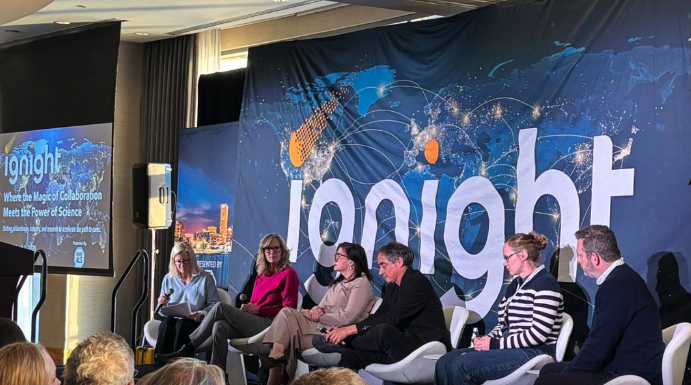
Topics spanned the full arc of how ALS research progresses from raw information to potential therapies. Romero addressed why data harmonization and interoperability across institutions are so critical, pointing to programs like AMP ALS, the public-private partnership with the NIH and FDA that has built a centralized knowledge portal with more than 1,600 files from 13 clinical and molecular datasets. Roush spoke to what cloud-scale infrastructure makes possible when ALS research is generating enormous multi-omics and longitudinal datasets, and how on-demand computing power lets researchers test more hypotheses and validate findings faster. Thompson gave the audience a window into Neuromine, Answer ALS’s open-access portal that she oversees, which houses more than 150 terabytes of harmonized data from over 2,500 deeply characterized participants. Since its launch, more than 580 independent ALS research projects have been initiated through the platform around the globe, making it the largest open-access resource of ALS data ever available. Pawlosky, who leads Google’s Accelerated Science lab in Zurich and is a principal investigator behind the AI co-scientist, a multi-agent system built on Gemini 2.0 that generates novel research hypotheses, discussed the kinds of biological patterns machine learning can surface that traditional methods might miss. Uffens addressed how GATC Health is applying its AI platform directly to the Answer ALS dataset through LADDIA, an AI drug discovery initiative funded by the State of Louisiana, to identify druggable targets. Durrett, a native Louisianan, was honored to highlight the state’s investment.
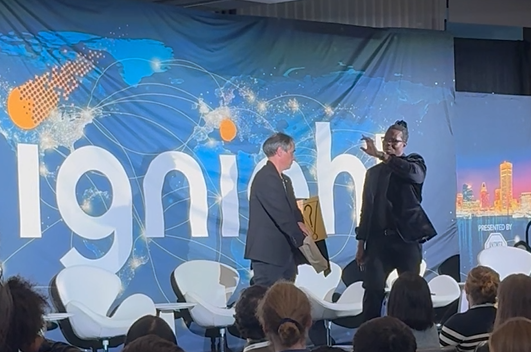
Following the panel, globally renowned magician and comedian Ran’D Shine took the stage. Shine has performed in 27 countries, appeared on CW’s Penn & Teller: Fool Us and Masters of Illusion, and has opened for comedian Trevor Noah. His performance brought the room together with laughter and awe after two hours of high-stakes science, and gave the evening’s title a second meaning.
Shine’s performance was the perfect bookend for an evening focused on making seemingly impossible feats achievable, and the laughter and magic he brought to the stage provided a necessary palate cleanser before four intense days of research sessions kicked off at the symposium. Bringing clinical experts and technology leaders under one roof forces a necessary collision of disciplines. Finding treatments for ALS demands analyzing massive datasets through entirely new perspectives, and the conversations initiated during the panel set an optimistic tone for the deep scientific work ahead.
Latest News
Guiding the Next Generation of ALS Researchers
Answer ALS holds the largest ALS patient data resource in the world, and it is helping aspiring youn...
Answer ALS Innovators of the Future Profile: Mrigank Pandey
When Mrigank Pandey began examining the biological mechanics of Amyotrophic Lateral Sclerosis (ALS),...
Answer ALS Innovators of the Future Profile: Ashwitha Surabhi
In their senior year at Thomas Jefferson High School for Science and Technology in Northern Virginia...
 Data & Technology
 Multi-Omnics Analysis
 IPS Cells & Motor Neurons
 Clinic & enrollment