
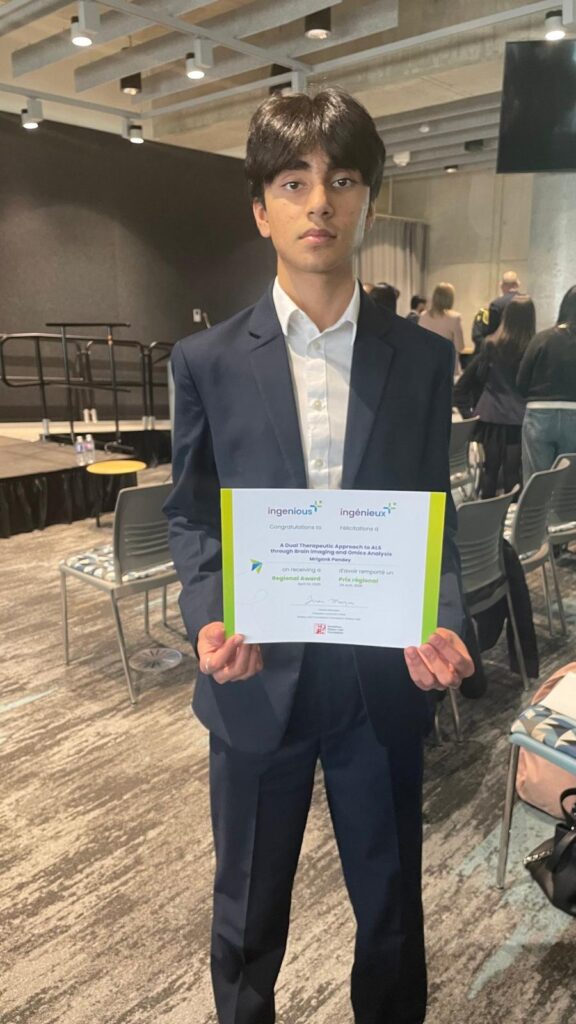
When Mrigank Pandey began examining the biological mechanics of Amyotrophic Lateral Sclerosis (ALS), he found two numbers that stood out to him. The first was 12 months, which was the amount of time it took for a family friend’s aunt to decline and pass away after her diagnosis. The second was 55 years, the length of time Stephen Hawking lived with the condition. This extreme variation in how the disease attacks the nervous system became his primary focus. A 10th-grade student at the STEM Innovation Academy High School in Calgary, Pandey wanted to look past traditional models and see if a systems-level approach could help decode the erratic progression of the disease. Instead of waiting for a formal academic track or a university internship to open up, he decided to design an independent research project for the Calgary Youth Science Fair. As he described his direct leap into advanced computational neuroscience, “I was done thinking that I’m going to wait for someone to teach me, or I’m going to wait for the perfect opportunity.”
His project targeted the disease under the title “A Multimodal Neuroimaging and Omics Approach for Rational Dual Therapeutic Design in Amyotrophic Lateral Sclerosis.” The underlying hypothesis suggested that attacking multiple biological pathways simultaneously using multi-target directed ligands (molecules that bind to specific target proteins) could offer a stronger alternative to traditional single-target drugs. Testing this idea required deep disciplinary knowledge and immediate access to high-fidelity proteomics data to isolate and map out specific protein targets. Accessing this data typically requires institutional backing because massive biological datasets are locked behind controlled-access walls. Pandey did not have a university affiliation or a laboratory sponsor, but his search for usable resources led him directly to the Answer ALS open-access data portal, Neuromine. “Coming across Answer ALS was a big step in my research,” he said. “It was really just about trying to gauge resources that I could realistically use.”
The open-access framework at Answer ALS ensures that foundational data needed to solve complex biological problems is available to anyone with the creativity to analyze it. Pandey found a contact email address listed on the public website and sent a cold message explaining his drug design model. Kelsey Valentine from the Answer ALS team responded to his inquiry and provided the baseline operational support he needed, guiding him through the setup process for an ADDI Workbench account. Answer ALS routes individual investigators to the ADDI Workbench environment to ensure researchers do not have to download massive clinical data repositories onto local high-performance computing clusters, an arrangement that allows the organization to monitor data usage and track analytics pipelines. When he began working with the data, the sheer technical scale of the information introduced an immediate learning curve. “Oh, that was a bit hectic, if I’m being honest,” Pandey recalled. He originally tried to work with raw, Level 1 FASTQ data files, but he found out quickly that his personal computer setup lacked the computational power to handle files of that magnitude. He pivoted to Level 4 proteomics data to match his technical resources.
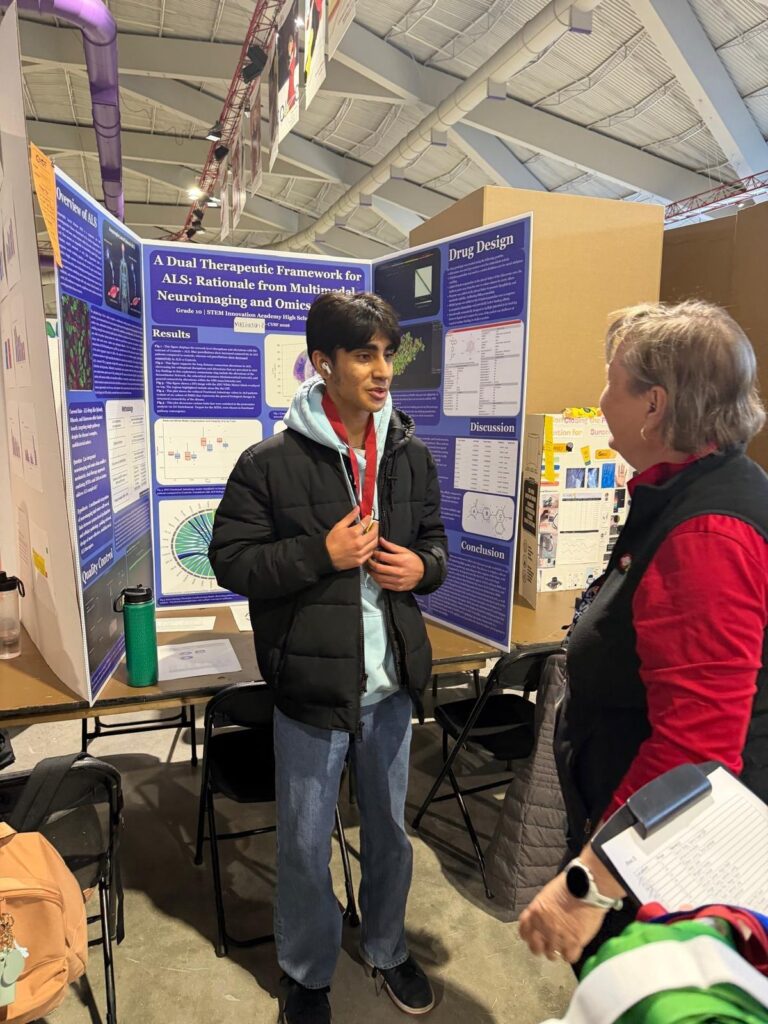
Inside the Neuromine portal, the platform allowed him to analyze visual graphs directly on the website and filter the data by demographics and disease subgroups. By analyzing these processed protein profiles across different patient demographics, Pandey explored potential molecular variations associated with rapidly progressing forms of the disease. His research concluded with a computational drug framework proposing dual-target ligands for those specific protein pathways, pointing toward a potential molecular strategy to disrupt multiple mechanisms of neurodegeneration simultaneously. “Without that data, then my project would have been quite unfinished, actually,” Pandey said.
The completed project won Pandey a gold medal and the UCalgary Young Biologist Award, and he is already planning to contact university labs to secure hands-on research opportunities before he finishes high school. Looking back at the moments when his direction was unclear, he views the intense technical struggle as an indicator of real progress. “There were times where, like, I really didn’t know how to progress,” he reflected, adding that “feeling in over your head…is just a sign that you’re actually learning something.” By stripping away traditional institutional gatekeepers and making massive clinical datasets public, Answer ALS is fundamentally altering who can participate in medical discovery and providing a pathway for the scientists of tomorrow. Open-access datasets allow a high school student with a personal computer and a sharp hypothesis to engage directly with high-level data. By opening these digital doors, Answer ALS is turning complex medical repositories into a training ground for future researchers and future groundbreakers.
Latest News
NFL Commits $500,000 to Champion Insights to Investigate Why Athletes, Veterans, and First Responders Face Higher ALS Risk
NEW ORLEANS, October 20, 2026 ⎯ Answer ALS announced that the National Football League (NFL) has c...
Why This NFL Owner Is Stepping Up for ALS Research
From INSIDE PHILANTHROPY, By Connie Matthiessen, October 13, 2026 National Football League players e...
Guiding the Next Generation of ALS Researchers
Answer ALS holds the largest ALS patient data resource in the world, and it is using that resource t...
 Data & Technology
 Multi-Omnics Analysis
 IPS Cells & Motor Neurons
 Clinic & enrollment