

National Football League players enjoy celebrity status, as well as stratospheric salaries and lucrative ad sponsorships. They are also nearly four times more likely to develop ALS than the general population.
A long list of former NFL players have been diagnosed with amyotrophic lateral sclerosis (ALS), the fatal motor neuron condition also known as Lou Gehrig’s disease. Arthur M. Blank wants to know why — and what can be done about it.
Blank is known not only for cofounding The Home Depot and for his expansive giving, but also as an NFL team owner: He purchased the Atlanta Falcons franchise in 2002. His philanthropy, the Arthur M. Blank Family Foundation, recently committed $4.4 million in grants to three programs that advance ALS research, expand access to clinical trials, and aim to increase understanding of the disease.
To decide how to make the most impact and channel the foundation’s resources, the Blank Foundation turned to two former NFL players who have the disease, Steve Gleason and Tim Green. Both men have become advocates for ALS patients and for research into the disease.
“I’ve always been inspired by Steve Gleason and Tim Green and the courage and purpose they have demonstrated in the face of a devastating disease,” Arthur Blank said in a written statement. “…Together, we are optimistic that we are moving closer to life-changing treatments, and I’m honored to support this critical mission.”
NFL stars and a devastating diagnosis
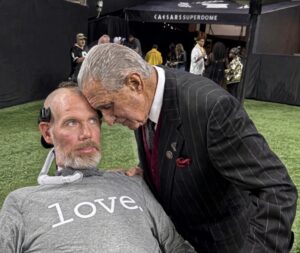 Twenty years ago, as a player for the New Orleans Saints, Steve Gleason executed a legendary blocking punt at the city’s Superdome, recently reopened after Hurricane Katrina. The Saints won the game, and some have called Gleason’s play “the rebirth of New Orleans.” Today, Gleason, who was diagnosed with ALS in 2011, uses a wheelchair and communicates by moving his eyes across a special keyboard. As he told ABC News in a recent interview, “I cannot move, talk or breathe on my own. Some days are brutal. And still, this is a miraculous, wonderful life.”
Research has linked professional football participation to elevated ALS risk, although the reasons remain under investigation. Repeated head impacts are also linked to chronic traumatic encephalopathy (CTE).
A recent study published in the British Medical Journal found that close to 25% of former NFL players who died between 2016 and 2021 had CTE at death, and the lead researcher on the study told NPR the total could be much higher. Another recent study found that NFL players are four times more likely to die of neurodegenerative diseases, including amyotrophic lateral sclerosis (ALS), dementia and Parkinson’s disease, than the general population.
ALS leads to progressive loss of motor function and muscle control. Former NFL running back Chris Johnson, who disclosed in June 2026 that he was diagnosed with ALS in 2025 at age 39, described how the disease changed his life. “Just over a year ago, I was picking up my seven-year-old daughter so she’d make a wish with her birthday cake,” he told ABC News, “Today, I couldn’t do that.”
Gleason and Green, a former Atlanta Falcons linebacker who was diagnosed with ALS in 2016, have both used their respective platforms to raise awareness and support research and potential treatments. Gleason founded Team Gleason, which provides support, equipment, adventure opportunities and care for people living with ALS. Answer ALS, where he is a cofounder and board member, is working to accelerate the development of treatment and cures for ALS. Green started Tackle ALS, which raises money for the Sean M. Healey & AMG Center for ALS at Mass General Brigham.
The NFL’s institutional response to high rates of brain injury among players remains a matter of debate. We recently covered the NFL Foundation, the league’s affiliated philanthropy, which centers its work on causes like youth sports and supporting player giving. Separately from the foundation, the NFL has committed $40 million toward primarily neuroscience-focused medical research through an initiative called Play Smart. Play Safe.
What’s the Blank Foundation funding?
Tim Green and Steve Gleason’s knowledge and experience informed the Blank team as they decided on which areas of ALS work to support.
“Gleason and Green highlighted several ALS initiatives they felt had the greatest potential to drive meaningful breakthroughs,” Blank said in his recent statement. “After careful review, we identified three areas where we believe philanthropic investment could help accelerate progress and address critical gaps in the field.”
The first of the three programs that will receive funding is the Consortium of ALS Research Laboratories (CARL), a group of scientists working together to rapidly move ALS therapies to clinical testing.
A second grantee, Acceleration Centers of Enrollment (ACE), will use the Blank funding to bring its model to the Louisiana-based Ochsner Health system. ACE’s model, which has been piloted at ALS centers in Boston, Chicago and Minneapolis, increases research capacity and gives more patients access to clinical trials and promising treatments.
A third grantee, Champion Insights, is a research initiative launched by Gleason’s Answer ALS, alongside Augie’s Quest to Cure ALS. The research program is working with the ALS Therapy Development Institute (ALS TDI) to understand why specific populations — including military personnel, first responders and high-performing athletes — are diagnosed with ALS at higher rates than the general public.
The Blank Foundation’s new support lands in a funding environment of relative scarcity: There isn’t much public and private funding for ALS, as is true for most diseases that affect a relatively small population. The Trump administration’s assault on the government, meanwhile, has exacerbated the problem with steep cuts to scientific research, including in the area of health.
The Arthur M. Blank Family Foundation has been supporting ALS-related efforts since 2016; the recent grants bring its total ALS commitment to $6 million. Other ALS funders include the ALS Association, a longstanding nonprofit that originated the viral “ALS Ice Bucket Challenge,” and the axeALS Foundation, which was created by Eric Stevens, another former NFL football player with ALS, and his wife, Amanda.
A moment of transition for the Blank Foundation
Today, Arthur Blank’s fortune exceeds $12 billion, according to Forbes. The 84-year-old signed the Giving Pledge in 2012, and his foundation has grown into a larger, professionalized philanthropy in recent years, supporting a broad range of causes. It has provided funding for organizations promoting democracy, historically Black colleges and universities, rural causes, gun violence prevention, youth mental health and environmental issues. The foundation prioritizes Atlanta and Montana, two regions that Blank and his family call home.
The foundation is in the midst of a transition. Last May, foundation president Fay Twersky, who many credit with broadening the focus and reach of the foundation, announced that she is stepping down. The foundation is conducting a national search and Twersky will stay on until her successor comes on board.
But Blank and his foundation have demonstrated that they are willing to take on big challenges — including ALS. For the many Americans who love football — including, presumably, most team owners — the game’s often-devastating health consequences are an uncomfortable reality they may prefer not to dwell on as they settle down with a beer and hot wings on a Sunday afternoon. This foundation, however, isn’t looking away. One question going forward is whether more of the ultra-rich donors and other wealthy interests in the NFL universe will follow suit.
As Steve Gleason said in a written statement, “[Arthur Blank] listens, he understands what is at stake, and he is willing to step up in a meaningful way. That kind of commitment moves us closer to a future where ALS comes with answers, not just uncertainty.”
Latest News
Guiding the Next Generation of ALS Researchers
Answer ALS holds the largest ALS patient data resource in the world, and it is using that resource t...
Answer ALS Innovators of the Future Profile: Mrigank Pandey
When Mrigank Pandey began examining the biological mechanics of Amyotrophic Lateral Sclerosis (ALS),...
Answer ALS Innovators of the Future Profile: Ashwitha Surabhi
In their senior year at Thomas Jefferson High School for Science and Technology in Northern Virginia...
 Data & Technology
 Multi-Omnics Analysis
 IPS Cells & Motor Neurons
 Clinic & enrollment